User-written IELTS example
Writing Academic Task 1 Band 6.0 Example
Original task prompt, user essay, band score, and related examples in the same report workspace.
Illustrative target band for this original model answer.
Plan your answer
Try your own response before reading the samples.
Ideas to explore
- Compare which series begins higher and which one ends higher; here, production starts slightly above consumption, but consumption finishes much higher.
- Identify the different rates of change: production rises gradually, while consumption accelerates after the early plotted years.
- Mention the axis-label problem: the task’s stated dates do not match the displayed years, and the last year is printed twice.
Suggested structure
- Introduce the graph, measures, and units.
- Give an overview of the overall direction and the main contrast between the two lines.
- Describe production’s starting level, plateau, and gradual later rise.
- Describe consumption’s early stability and sharper increase, then compare the final plotted values.
- Briefly note that the displayed dates are inconsistent or duplicated where this affects interpretation.
Useful vocabulary & examples
- rose gradually
- increased slowly over time
Oil production rose gradually after remaining near 3 million barrels per day.
- remained stable
- stayed at approximately the same level
Production remained stable at around 3 million barrels per day for a period.
- increased substantially
- went up by a large amount
Consumption increased substantially and reached about 6.3 million barrels per day at the final plotted point.
- the gap widened
- the difference between two values became greater
The gap between oil consumption and production widened as consumption climbed.
Task Prompt
User Essay Analysis
Review the public answer with report-style highlights.
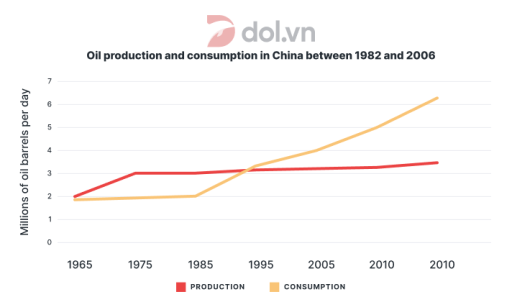
The provided line graph illustrates the fluctuations of Chinese production and consumption of the oil over a period of 24 years, commencing in 1982. Overall, the figures of both oil producing and consuming recorded an upward trajectory. However, while the Chinese oil-making industry saw a gradual growth, it seemed that the volume of oil used increased considerably faster.
Overall, both series increase, but consumption rises much faster and finishes well above production. Production initially exceeds consumption, before the two lines cross in the middle of the displayed sequence.
At the first plotted point, production is about 2 million barrels per day, slightly above consumption at approximately 1.8 million. Production rises to around 3 million at the next point and remains near that level for a time. It then increases only gradually, ending at roughly 3.5 million barrels per day.
Consumption is initially almost stable at around 2 million barrels per day. It subsequently rises to a little above 3 million, passing production, and continues to approximately 4 million before increasing more steeply. At the final point it reaches about 6.3 million barrels per day, leaving a gap of roughly 2.8 million above production.
The title states 1982–2006, but the horizontal axis displays different years and repeats its final label. The trend and values can be described from the plotted points, while the image does not support a reliable year-by-year account for the period named in the title.
Targeted Improvement Tips
Related examples for this topic
Compare different bands on the same IELTS prompt.
The line graph illustrates the amount of oil produced and consumed daily in China from 1982 to 2006, measured in millions of barrels day. Overall, it can be seen that both oil p...
Band 8.0The line graph illustrates the trends in oil production and consumption in China from 1982 to 2006, measured in millions of barrels per day. Overall, both production and consump...
Band 7.0The line graph illustrates the daily amount of oil consumed and produced in China from 1982 to 2006. It can clearly be seen that China saw increases in both oil production and c...
Band 6.0The line graph illustrates China’s production and consumption of oil from 1982 to 2006. In this period, the amount of oil being produced has remained relatively constant. On the...
Band 5.0This line graph provides information about the consumption and production of oil in China from 1982 to 2006.The data is measured in millions of oil barrels per day. Overall,ther...
Band 4.0The line chart illustrates the proportion of oil production and consumption in China among 1982 to 2006. Overall,it can be seen that oil consumption seems more dominant and pref...
