User-written IELTS example
Writing Academic Task 1 Band 5.0 Example
Original task prompt, user essay, band score, and related examples in the same report workspace.
Illustrative target band for this original model answer.
Plan your answer
Try your own response before reading the samples.
Ideas to explore
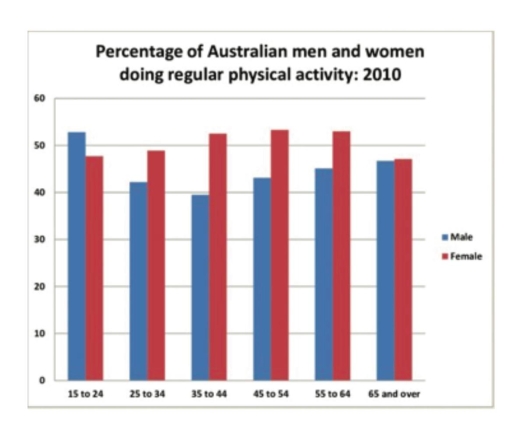
- Compare the sexes by age band: men have the higher rate only among 15–24-year-olds.
- Describe the contrasting patterns: the male rate falls to a low among 35–44-year-olds before recovering, while the female rate rises to a plateau above 50% from ages 35 to 64.
- Highlight the endpoint: the two rates are almost equal among people aged 65 and over.
Suggested structure
- Introduce the chart, population, measure, age groups, and year.
- Give an overview of the main gender contrast and the near-equal oldest-group figures.
- Describe the male figures across the age groups, noting the low and later recovery.
- Describe the female figures, noting the rise and peak, then compare the oldest group.
Useful vocabulary & examples
- participation rate
- The percentage of a group taking part in an activity.
The male participation rate reached its lowest point among 35–44-year-olds.
- reach a low
- Fall to the smallest value in the figures being discussed.
The figure for men reached a low of roughly 39% in the 35–44 age group.
- peak at
- Reach the highest value in a set of figures.
Female participation peaked at approximately 53% in two age groups.
- remain almost level
- Be very similar, with only a small difference.
The male and female rates remained almost level among those aged 65 and over.
Task Prompt
User Essay Analysis
Review the public answer with report-style highlights.
The broad assessment of the data reveals that male and female population of Australia did sport regularly in 2010 in all ages in almost similar proportion. The main feature of this research, women were the most physical active in all age more than men. The exeption were only women from 15 to 24 years old—in this group, men recorded a higher rate, at roughly 53%, compared with approximately 48% for women. Among people aged 25 to 34, the female figure was close to 49%, while the male figure was about 42%. The gap was wider in the 35-to-44 group, with around 52% of women exercising regularly, compared with approximately 39% of men. Women’s rates then remained at about 53% for both the 45-to-54 and 55-to-64 groups, while the corresponding male figures rose gradually, from roughly 43% to 45%. In the oldest group, people aged 65 and over, the proportions were almost equal, at approximately 47% for both sexes. Overall, men’s participation was highest in the youngest group and lowest among those aged 35 to 44, whereas women’s rate was lowest among 15-to-24-year-olds and highest in the middle-aged groups.
Targeted Improvement Tips
Related examples for this topic
Compare different bands on the same IELTS prompt.
The bar chart presented illustrates the proportion of Australian men and women engaging in regular physical activity across various age groups in the year 2010. Overall, the dat...
Band 8.0The bar chart given below indicates the data from Australia that provides the proportion of males and females in various age intervals who train themselves regularly in 2010. It...
Band 7.0The bar graph provided shows a comparison of the levels of physical exercise among Australian men and women in different age groups in the year 2010. In 2010, the percentage of...
Band 6.0The bar chart compares the percentage of Australian males and females in different age groups from 15 to over 65 years old doing regular exercises in 2010. It’s clear that males...
Band 5.0The bar charts illustrate the proportion of men and women of various age categories in Australia who participated in physical activity on a daily basis in the year 2010. In gene...
Band 4.0The provided bar graph illustrates the number of Australian men and women in six various age groups who did daily physical activity in the year 2010. Overall, it can be seen tha...
