User-written IELTS example
Writing Academic Task 1 Band 8.0 Example
Original task prompt, user essay, band score, and related examples in the same report workspace.
Illustrative target band for this original model answer.
Plan your answer
Try your own response before reading the samples.
Ideas to explore
- Further study was the leading destination for both graduates and postgraduates.
- Voluntary work was the least common option in each group.
- Graduate counts exceeded postgraduate counts in all four categories, with the biggest absolute difference in further study.
Suggested structure
- Paraphrase the chart topic and specify the year and population.
- Give an overview of the shared highest and lowest categories.
- Report graduate figures in rank order, grouping the leading choices and the smaller categories.
- Report postgraduate figures in the same order to make comparisons easy.
- Close with the most notable difference between the two groups.
Useful vocabulary & examples
- the most common destination
- The option chosen by the largest number of people.
Further study was the most common destination for both groups.
- ranked second
- Was the second-highest category in a set of figures.
Part-time work ranked second for graduates.
- by contrast
- A linking phrase used to introduce a noticeably different figure or fact.
By contrast, only 3,500 graduates undertook voluntary work.
- the largest difference
- The greatest gap between two compared figures.
The largest difference between the groups was in further study.
Task Prompt
User Essay Analysis
Review the public answer with report-style highlights.
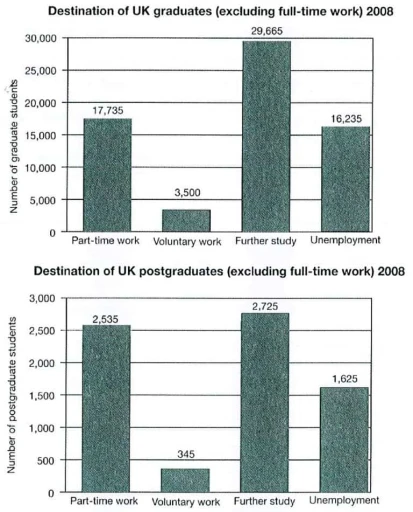
These bar charts provide information on the destinations of UK graduate and postgraduate students who were not engaged in full-time work in 2008. it is clear that a higher number of both graduates and postgraduates chose further study compared to other options. Additionally, interest patterns among graduates and postgraduates followed similar trends in 2008. Among graduates, further study was the most common destination, at 29,665. Part-time work ranked second with 17,735, followed by unemployment at 16,235; voluntary work was much less common, at 3,500.
For postgraduates, further study also led the list, with 2,725 people, only slightly above the 2,535 who entered part-time work. Unemployment accounted for 1,625, while voluntary work was again the least popular option, at 345.
Overall, therefore, the two groups shared the same ranking: further study came first and voluntary work last, while part-time employment and unemployment occupied the middle positions. The number of graduates was higher than the postgraduate figure in every destination, and the largest gap was in further study. However, the charts show counts rather than proportions, so they do not establish that graduates were more likely to choose any particular route.
Targeted Improvement Tips
Related examples for this topic
Compare different bands on the same IELTS prompt.
The charts illustrate the various destinations of UK graduate and postgraduate students who did not enter full-time employment after graduating in 2008. For graduates, the major...
Band 8.0The charts provide information on the activities of UK graduate and postgraduate students who did not secure full-time employment after leaving college in 2008. From an overall...
Band 7.0The bar chart depicts about the occupation and study status of graduates and postgraduates from the United Kingdom after finishing college,except for full-time work in 2008. In...
Band 6.0The bar charts given shows the amount of UK graduates and postgraduates went to different pathways after leaving college, instead of working as a full-time job, in 2008. Compari...
Band 5.0The bar charts provides information about what Uk Bachelor’s and Master’s degree graduates did after finishing college beside getting a full time job in 2008. Overall, it seems...
Band 4.0The given bar charts give information about how English graduate and post graduate students who do not have full time job spend their time after leaving collage in 2008. It can...
